I’m a vocal supporter of open-source projects. The last twelve months have made the case for me more clearly than I could have made it myself.
n8n just raised a $180M Series C at a $2.5 billion valuation. An open-source automation tool, born in Berlin, now valued higher than most of its closed-source competitors and surpassing Zapier in Google search interest. (For the production self-hosted side of n8n, my n8n self-hosted workflow automation post is the deployment companion to the strategic angle here.)
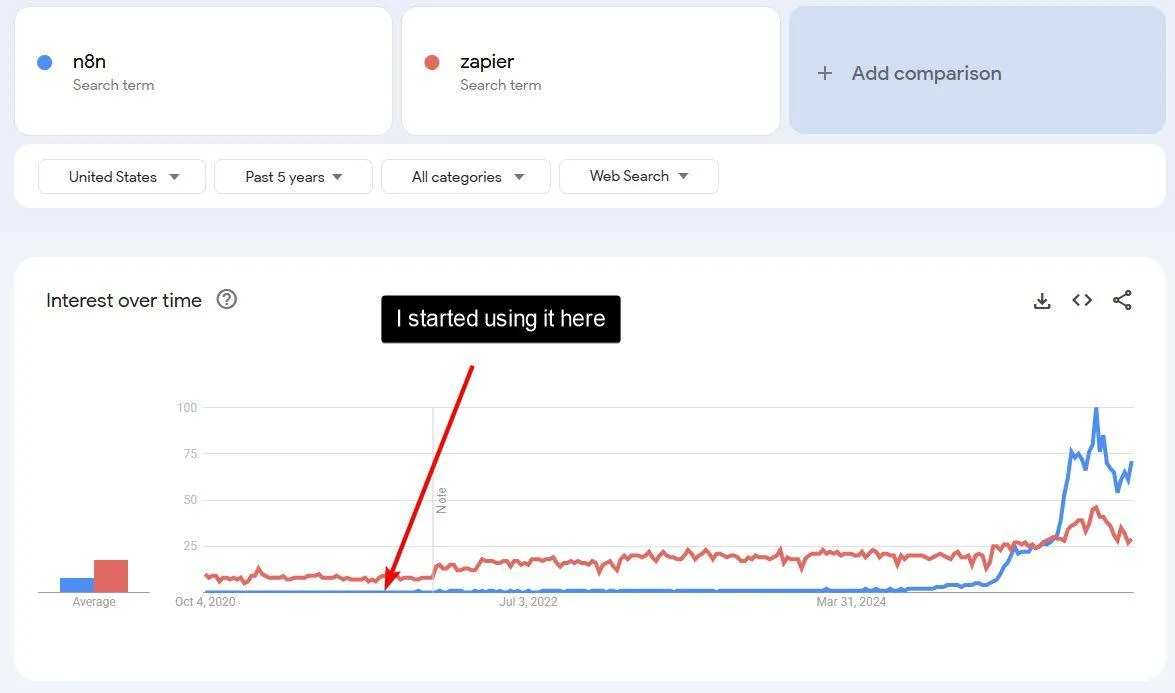
Five years of Google search interest. The blue line is n8n; the red is Zapier. The crossover happened in late 2024.
That’s not a fluke. Pangolin, under a year old, has crossed 15,000 GitHub stars, 3,600 Discord members, and almost 1,000 individual donors. They closed a $4.7M seed round through Y Combinator in August. Netbird, another Berlin project, has raised $5.41M across four rounds (the technical side of why I run it for distributed teams is in my Netbird Zero Trust mesh VPN post). And those are just the ones I’ve watched closely.
The pattern matters. Open-source is no longer a community hobby. It’s a business model that scales on transparency, collaboration, and trust, and it’s outcompeting closed-source incumbents in real markets.
These projects show what happens when you focus on a real problem and build openly. The community becomes your investor. Not just financially, but through contributions, feedback, and the kind of advocacy paid marketing cannot buy.
It’s not an easy path. Open-source founders have to balance free accessibility with sustainable revenue, whether through hosted versions, premium features, or enterprise support. But when it works, it’s one of the most authentic and durable business models out there.
There’s a real risk worth naming. A project can flip the switch at any time: change licenses, go closed-source once they hit traction or close a funding round, or paywall the features the community helped build. It happens often enough that “open-source today” isn’t always “open-source tomorrow”. The community has to stay aware.
I think we’re entering an era where open-source and business success do not compete. They complement each other.
If you want the agency-side view of how this plays out in practice (which open-source tools end up in the stack, why I default to FOSS-first), the self-hosted agency stack foundations post is the operational companion to this strategic one.
What do you think? Can open-source be the foundation of a profitable, long-term business, or will it always rely on VC money and goodwill?