Most home and small-business networks fail the same security audit: the router is the only firewall, DNS is whatever the ISP hands out, the VPN is whatever Windows ships with, and there’s no monitoring at all. Each piece works in isolation. Together they leave gaps a determined attacker walks through in an afternoon.
Mistborn, built by Stormblest, takes a different approach. Instead of leaving you to assemble WireGuard, Pi-hole, a SIEM, and a firewall yourself, it ships them as one integrated suite with the security posture wired in by someone who actually knows what they’re doing. The maintainer holds both CISSP and OSCP certifications, which matters here because Zero Trust isn’t a marketing line on the project page; it’s the design priority.
This post covers what’s in Mistborn, who it’s actually for, and how the Webnestify managed-Mistborn engagement fits in if running it yourself isn’t the trade you want.
What Mistborn is
Mistborn is a virtual private cloud platform that brings together open-source security tools into a single self-hosted suite. The core stack:
- WireGuard for encrypted VPN access (with multi-factor authentication on top).
- iptables for the firewall layer.
- Pi-hole for network-wide ad-blocking and outbound DNS filtering.
- DNScrypt to prevent DNS spoofing.
- Traefik as the modern reverse proxy fronting the services.
- Cockpit for the management GUI.
- Docker for service containerization.
Optional security modules:
- Wazuh for SIEM-grade security monitoring.
- Suricata as a network-layer threat detection engine that feeds into Wazuh.
And a long list of optional self-hostable apps that run on top of the stack: Home Assistant, Nextcloud, Vaultwarden, Syncthing, OnlyOffice, Rocket.Chat, Jellyfin, Tor, Jitsi, Guacamole, RaspAP, and more. The point isn’t that you’ll run all of them; it’s that adding any of them is a few clicks instead of a weekend of YAML.
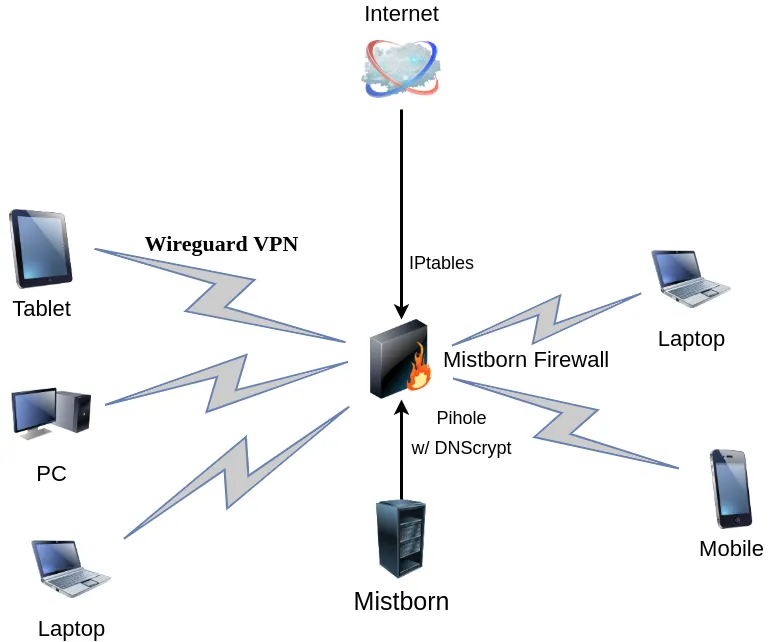
Mistborn’s network architecture: a hardened perimeter with WireGuard as the only ingress, Pi-hole filtering outbound DNS, and the service layer running behind Traefik on an internal network.
How the Zero Trust posture is enforced
A few of the design decisions that make Mistborn a Zero Trust platform rather than just “a server with a VPN”:
- Network-layer access. WireGuard is the primary authentication method. There’s no public-facing port other than the WireGuard endpoint. If you’re not on the VPN, you can’t even see the services.
- MFA on top of WireGuard. A second factor binds the device key to a human, so a stolen laptop doesn’t grant network access on its own.
- Outbound filtering. Pi-hole blocks outbound requests to malicious or tracking domains at the DNS layer. This stops a compromised internal device from beaconing to a known C2 server before any external firewall sees the traffic.
- DNS encryption. DNScrypt prevents man-in-the-middle attacks on DNS, which is the layer most home networks leak the loudest at.
- SIEM integration. When the optional Wazuh + Suricata modules are enabled, you get enterprise-grade security monitoring across the entire stack with one dashboard.
Who Mistborn is actually for
The honest fit:
- Small businesses that want one secure platform for VPN, file sharing, password management, and monitoring without hiring a part-time sysadmin.
- Privacy-focused families running shared self-hosted services (a media server, a password vault, a calendar) and wanting a consistent security model across them.
- Home labs of people who already know they want WireGuard plus a SIEM, but don’t want to integrate everything by hand.
- Agencies running an internal server for staff tools (file sync, password vault, support docs) and wanting a hardened environment from day one.
When I’d reach for something else:
- Multi-region or HA workloads belong on a different architecture (Tailscale plus a dedicated SIEM, or Netbird plus Wazuh on separate infra).
- Single-purpose deployments (you only need WireGuard, or you only need Pi-hole) should install that one component directly.
- Hosts with very tight resource constraints may struggle with the full Wazuh + Suricata module; the core stack runs comfortably on modest hardware, but the optional SIEM is heavier.
Webnestify partnership
Webnestify partners with Stormblest to deliver managed enterprise Mistborn instances for businesses that want the security posture without operating it themselves. That covers the initial hardening pass, WireGuard peer enrollment for the team, DNS and MFA configuration, optional SIEM module setup, ongoing patching, and incident response if anything trips. The split of work is the same as the rest of my managed engagements: you run the business; I run the infrastructure.
The interview below with Steven Foerster (founder of Mistborn and Stormblest) covers the philosophy behind the suite in more depth than any blog post can. It’s a 90-minute conversation; I’d recommend the full thing if you’re seriously evaluating Mistborn for your own setup.
Closing the loop
Mistborn is the rare open-source project that takes security seriously at the architecture level instead of bolting it on. For the right workload (small business, home lab, privacy-focused family, internal agency server) it does in one install what would otherwise be a month of glue work.
If you’d rather see the full installation walkthrough (the Pi-hole adlists I trust, the DNSCrypt switch, and what the hardened-Debian baseline looks like before Mistborn lands), my Mistborn self-hosted deployment guide is the technical companion to this post.
If running it yourself sounds like one more thing to keep alive, reach out through the contact page and we can scope a managed Mistborn deployment under the partnership above. For the broader open-source toolkit I run for clients, the open-source solutions category has the rest, and the cybersecurity & hardening writeups cover the security side in more detail.