On 7 May 2026, a new Linux kernel privilege-escalation bug went public called Dirty Frag. Same family as Dirty Pipe and Copy Fail, same trick of writing into the kernel’s page cache from an unprivileged process, and a chained PoC that reaches root on every major distribution. Two hours after the disclosure dropped on linux-distros, every Webnestify-managed server had the mitigation deployed, every affected kernel module disabled, and the page cache cleared.
Customers got an email a few minutes after that, before most of them had seen the news.
I also posted the workaround on r/homelab the same evening. It went a bit viral. 175,000 views, 545 upvotes, 54 comments. That says less about the post and more about how unprepared the wider operator community was. Most homelab operators read about Dirty Frag for the first time in that thread.
Here’s what the bug does, why this disclosure was unusual, and what the day-of response looked like from inside a managed-infrastructure shop.
What Dirty Frag actually is
Dirty Frag is a logic bug, not a race. The Linux kernel keeps a working copy of every file the system uses in memory. That cache is called the page cache, and programs read from those copies rather than from disk. The kernel is supposed to be the only thing that can write to them.
Dirty Frag breaks that rule from two different angles, both reaching the same outcome. By corrupting the frag member of struct sk_buff from inside one of two vulnerable kernel modules, an unprivileged user can write a few bytes into the in-memory copy of any file the kernel has cached. Pick /usr/bin/su. Inject shellcode. Run su. The kernel loads the corrupted in-memory binary. Your shellcode runs as UID 0.
The on-disk binary is never touched. File-integrity checks see nothing.
If that sounds familiar, it should. This is the same bug class as Dirty Pipe in 2022 and Copy Fail last week. The discoverer, Hyunwoo Kim, explicitly framed Dirty Frag as the descendant of both: a deterministic logic bug that “dirties” the frag member instead of the pipe buffer or the algif_aead destination scatterlist.
Two CVEs, chained, one PoC
Dirty Frag is not one vulnerability but two, deliberately chained:
- CVE-2026-43284 (xfrm-ESP Page-Cache Write). Lives in the IPsec ESP transformation modules (
esp4,esp6). Provides a 4-byte arbitrary STORE primitive into any cached page. Available on basically every Linux distribution. Requires the privilege to create a network namespace, which most distros allow unprivileged by default. - CVE-2026-43500 (RxRPC Page-Cache Write). Lives in the
rxrpc.komodule. Same class of bug, same write primitive, but does not require namespace creation. Loaded by default on Ubuntu.
The chain is the smart part. Some distributions block unprivileged user namespaces through AppArmor (Ubuntu does this on many configs), which would close the xfrm-ESP path. But Ubuntu also loads rxrpc by default, which the second variant uses. Other distributions don’t ship rxrpc at all but happily allow unprivileged namespace creation, which is exactly what xfrm-ESP needs. Chain the two and both blind spots cover each other. Root falls out on every mainstream distro.
The proof of concept is a single C program. Compile, run, root shell.
Why this disclosure was unusual
A normal Linux kernel CVE goes through a coordinated process. The researcher reports privately, distributions get a 30 to 90 day grace period, patches are pre-built, and the public announcement lands the same day every distro ships a fixed kernel. By the time you read about it on Hacker News, apt upgrade already has the fix.
Dirty Frag did not get that. The embargo broke before distributions could prepare. There was no coordinated patch window. The researcher consulted with the linux-distros maintainers, was told to publish anyway, and the writeup went live with no fixed kernel waiting in any distribution’s repository.
That is a bigger deal than the average advisory because:
- There is no
apt upgradebutton to push. Every operator has to manually disable kernel modules until distros backport the fix. That is not the workflow most teams have rehearsed. - Half the bug pair is still unpatched anywhere. As of 8 May 2026, mainline accepted commit f4c50a4034e6 for the xfrm-ESP variant (CVE-2026-43284). The RxRPC variant (CVE-2026-43500) has no patch in any tree. Even after distros backport the first patch, the second exposure stays open until a separate fix lands.
- The PoC is public and trivial to run. One
git clone, onegcc, one binary execution. Anyone with shell access on a vulnerable box can be root in seconds.
The Reddit moment
I posted the workaround on r/homelab two hours after the disclosure landed. The thread looked like this:
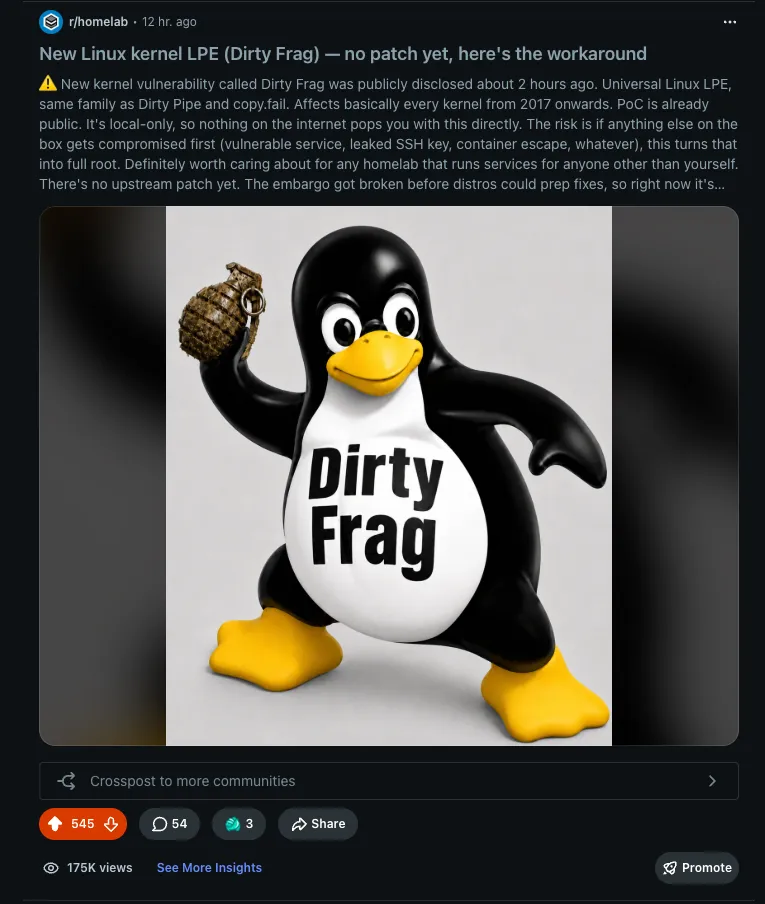
The post hit 175,000 views and 545 upvotes inside twelve hours. Not because the writing was anything special, but because the wider homelab and small-shop operator community had not yet seen Dirty Frag, and a working step-by-step mitigation was the thing they needed.
Two takeaways from the comments. First, several operators of small fleets were patching live, in the thread, while we were talking. Second, the gap between “researcher publishes” and “operators have a tested mitigation in hand” was much wider than people assumed. Closing that gap is exactly the job a managed host is supposed to do.
What we did the day Dirty Frag dropped
The Webnestify response had four parts, all inside a roughly two-hour window.
Detect. I was watching the linux-distros and oss-security mailing lists when the writeup landed. The chained-PoC repo went live a few minutes later.
Mitigate. Across the managed fleet:
sh -c "printf 'install esp4 /bin/false\ninstall esp6 /bin/false\ninstall rxrpc /bin/false\n' > /etc/modprobe.d/dirtyfrag.conf; rmmod esp4 esp6 rxrpc 2>/dev/null; echo 3 > /proc/sys/vm/drop_caches; true"That command does three things. It blacklists the three vulnerable modules so they cannot be loaded again. It removes them from the running kernel. And it drops the page cache, which matters because if anyone had triggered the bug pre-mitigation, the corrupted cached pages would persist until evicted. None of the steps require a reboot. None of them caused downtime.
Notify. Customers got an email before most of them had seen the news. Verbatim:
You may have already seen the news about a new Linux kernel vulnerability called “Dirty Frag”, disclosed publicly just 2 hours ago with a working exploit released alongside it. It is a serious local privilege escalation flaw affecting nearly every Linux distribution from 2017 onwards, in the same family as the recent Copy Fail.
Your server is already protected. We deployed the mitigation across our entire managed fleet within 2 hours of public disclosure, with no downtime and no impact on your sites. By the time most sysadmins were reading the news, your server was already secured.
Unlike Copy Fail, there is no upstream Linux patch available yet. The embargo was broken before distributions could prepare fixes, so for now the only protection is a temporary kernel-module workaround, which is what we have applied. As soon as patched kernels ship from upstream, we will roll them out across the fleet during a scheduled reboot at off-peak hours, and we will email you separately when that maintenance is planned.
Help everyone else. Once the fleet was clean I sent the chained-PoC behaviour and the exact mitigation to a couple of CTOs at neighbouring control-panel platforms whose customers I know. The blast radius shrinks when the wider community moves together. Copy Fail proved that, and Dirty Frag deserved the same treatment. I won’t name the platforms here. They can do that themselves once their patches are out.
How to mitigate Dirty Frag on your own server
If you’re not on managed hosting, here’s the order of operations. (If you’re missing the basics like SSH key auth, sudo users, and UFW, start with the Linux server security fundamentals walkthrough before any of this.)
Mitigate first, with the exact one-liner from the disclosure:
sh -c "printf 'install esp4 /bin/false\ninstall esp6 /bin/false\ninstall rxrpc /bin/false\n' > /etc/modprobe.d/dirtyfrag.conf; rmmod esp4 esp6 rxrpc 2>/dev/null; echo 3 > /proc/sys/vm/drop_caches; true"That blocks both the xfrm-ESP and RxRPC variants and clears any cached pages that could already be corrupted. Test in staging first if your stack uses IPsec ESP (some VPN configurations on the host) or AF_RXRPC sockets (rare outside specific Andrew File System workloads).
Then watch for the patched kernel. The xfrm-ESP fix landed in mainline as f4c50a4034e6 on 8 May 2026. Distros will backport over the coming days:
# Ubuntu / Debian
apt update && apt upgrade linux-image-generic

# RHEL / Amazon Linux / Fedora
dnf update kernel

# SUSE
zypper update kernel-default
Once the patched kernel is installed, reboot to activate. Keep the modprobe blacklist in place until both CVEs have a fix, especially for rxrpc. CVE-2026-43500 has no patch yet, and the blacklist is the only protection.
Don’t skip the page-cache drop. echo 3 > /proc/sys/vm/drop_caches is the difference between “the exploit can no longer run” and “the exploit can no longer run, AND any pre-mitigation contamination is gone”. File-integrity tools won’t tell you the cache was poisoned. The drop is cheap, runs in milliseconds, and removes the doubt.
Watch for behavioural anomalies. The exploit produces an execve of /usr/bin/su (or whichever cached binary it corrupted) from an unprivileged user that would not normally call it. If you don’t already have a behaviour-based defence layer running, CrowdSec is the one I install on day one and it will catch the kind of post-exploitation activity Dirty Frag enables.
What this changes about managed hosting
Dirty Frag is the second universal Linux LPE in nine days. Copy Fail dropped on 29 April. Dirty Frag landed on 7 May. Both went public with working exploits attached. Both bypass standard file-integrity monitoring because the corruption only exists in RAM. The frequency at which “this is the worst Linux kernel CVE in a decade” disclosures keep arriving is itself the new pattern.
That changes the job description for managed hosting. A decade ago, managed hosting meant “we keep the box running and reboot it when monitoring screams”. Today it has to mean something different. We read disclosure feeds at 9am on a Wednesday, mitigate before the embargo breaks the news cycle, and email you the explanation before you’ve seen the headline. The Copy Fail post covered the same response on 29 April. Dirty Frag is the same story nine days later, with a tighter window because no upstream patch existed yet.
If you’re running infrastructure for paying customers and you found out about Dirty Frag from this post, that is the gap.
Want this kind of cover?
Webnestify is a small managed-infrastructure shop for agencies and growing businesses. We watch Linux kernel disclosures, security advisories, and CVE feeds around the clock, including weekends, holidays, and the middle of the night. When something serious lands, we mitigate, patch, and email you before you’ve seen the news. The full picture of what runs on your server lives on the solutions page, and the cloud infrastructure audit is the lightweight way in if you want a second pair of eyes on the stack you already have.
Apply for a discovery call if you want to walk through your stack and risk profile. Thirty minutes, no slide deck.
P.S. If you’d rather start with the playbooks, the Webnestify YouTube channel has 130+ tutorials at the same depth, free, no commitment.
References
- V4bel/dirtyfrag, the official disclosure repository, including the chained PoC and the mitigation one-liner
- r/homelab thread, the original Reddit post and the operator discussion that followed
- CVE-2026-43284 mainline patch, the xfrm-ESP fix committed 8 May 2026
- Copy Fail (CVE-2026-31431), the previous post in the page-cache LPE series